
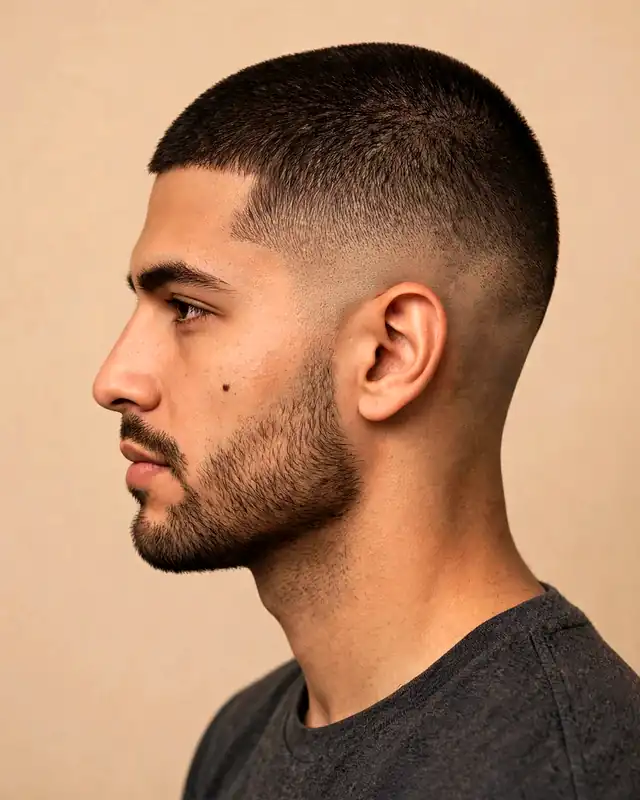
A low taper fade buzz cut is one short guard across the top, usually a #2 to #4, with the sides tapered down low around the ears and neckline. The taper keeps a little length at its shortest point, so the cut reads as clean rather than shaved. That sounds simple, and it is, until the barber asks which guard and how low. Two choices change the result: the top length and where the taper starts.
Get those right and the cut suits almost any face and hair type. Get them wrong and you walk out with a different haircut than the one you pictured. This guide covers both choices, the styles that work, and the exact words to use in the chair.
What a low taper fade buzz cut actually is
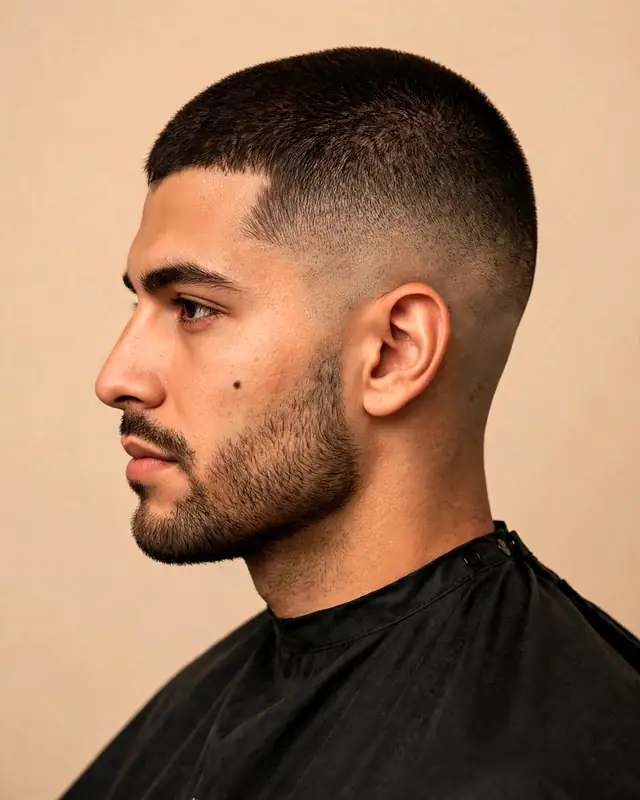
A low taper fade buzz cut keeps one even guard length on top, usually a #2 to #4, and tapers the sides down low near the ears and neckline. The taper shortens gradually and keeps some length at its shortest point.
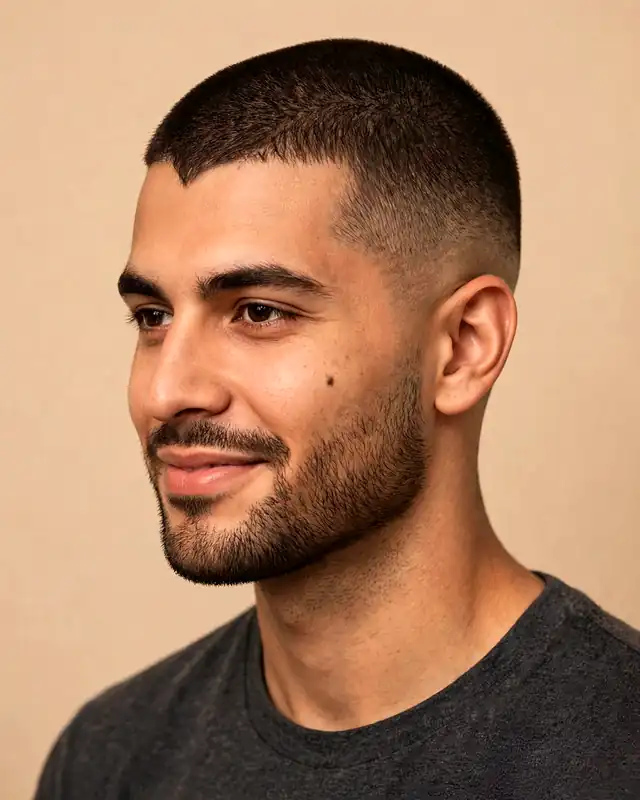
Two techniques make up the cut. The buzz sets the top: one guard, one even length, a dense brush of hair that needs no parting and no product. The taper shapes the sides and back, shortening the hair in small steps as it moves down toward the ears and neckline. Low describes where that shortening starts, just above the ear, so most of the side keeps its length.
Stand a few feet away and the cut can look like one even buzz. Step closer and the graduation shows, a soft shift from the top length down to the shortest length at the edges.
That subtlety is the point. A high fade announces itself across a room. This one reads as neat and deliberate up close.
Taper vs fade: the finish most people mix up
A taper and a fade differ at the bottom. A taper keeps a little length at its shortest point, usually a #1 guard, while a fade goes to bare skin. Mixing the two words up is the most common reason a cut comes back wrong.
Here is where the guides disagree. Most barber sources say a taper never reaches bare skin, that the shortest point keeps a #1 guard or a light trim. Other sources list skin, zero and #0.5 as base options for the same low taper, which makes the word taper cover two different finishes. Both camps describe real haircuts.
The practical fix is simple: name the finish out loud. Say “not to skin” or “finish at a #1” and the barber knows exactly where the bottom sits. Photos help too, but a photo shows a shape, not a guard number.
Words settle the finish. Photos settle the shape.
Low, mid and high: where the taper starts
Taper height describes where the blend starts on the head. A low taper starts just above the ear, a mid taper around the top of the ear, and a high taper near the temples. The higher the start, the more contrast between top and sides.
Placement sets the personality of a low taper fade buzz cut. A low taper keeps most of the side at full length, so the blend sits close to the ear and the grow-out stays gentle. A mid taper starts higher and shows more contrast, which suits men who want the fade to read clearly from across a room.
A high taper starts near the temples and turns the cut into a statement, with a long gradient from the top down to the skin or the shortest guard. A drop fade follows the curve of the head behind the ear instead of running straight around. When you ask, point to the spot on your own head. “Start it here” beats any adjective.
The styles barbers actually cut
The cut comes in several versions, and the differences sit in the top length and the edges. The classic uniform buzz is the baseline: one guard on top with a low taper. Line-ups, textured crops and beard blends all build on that base.
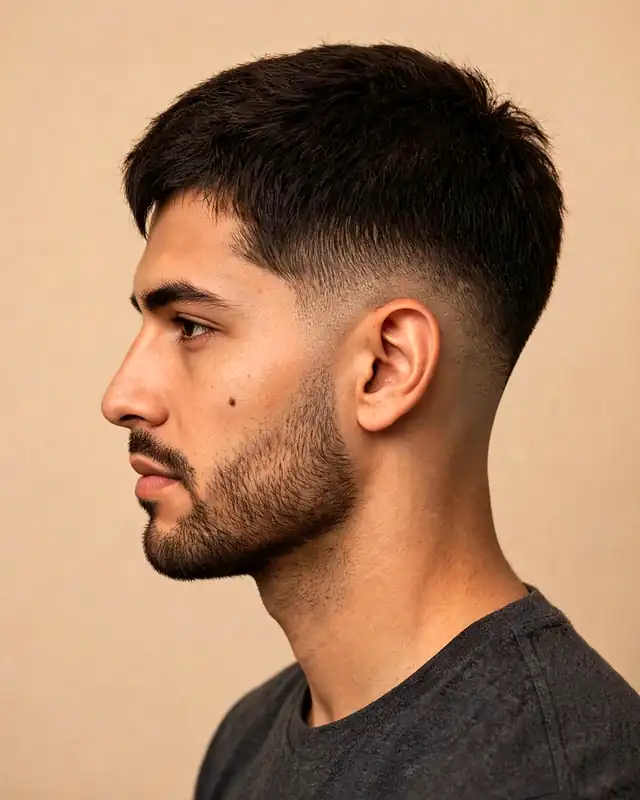
The classic uniform buzz is the default. One guard on top, usually a #3 or #4, with a low taper at the ears and a tidy neckline. It suits almost every face and every hair type, which is why barbers cut it more than any other version.
A line-up adds a razor-sharp front hairline and pairs well with a beard. A textured crop keeps the top longer, around a #4 or #5, and breaks the surface up with scissors or texturizing shears, which suits thick hair and men who want a little movement on top. A beard-connected version fades the taper into the beard along the jaw, so the hair and the beard read as one shape.
Curly and coily versions keep the top longer to allow for shrinkage and use clipper over comb for the blend. A faux hawk leaves a longer strip down the center and tapers the sides harder, while a skin fade version keeps the same shape and takes the bottom to bare skin. The military cut, a #1 all over with a low taper, is the shortest of the set.
Choosing your guard: #1 to #4 on top
The guard number sets the top length, and the jump between sizes is bigger in person than on paper. A #1 leaves 1/8 inch, a #2 leaves 1/4 inch, a #3 leaves 3/8 inch and a #4 leaves 1/2 inch.
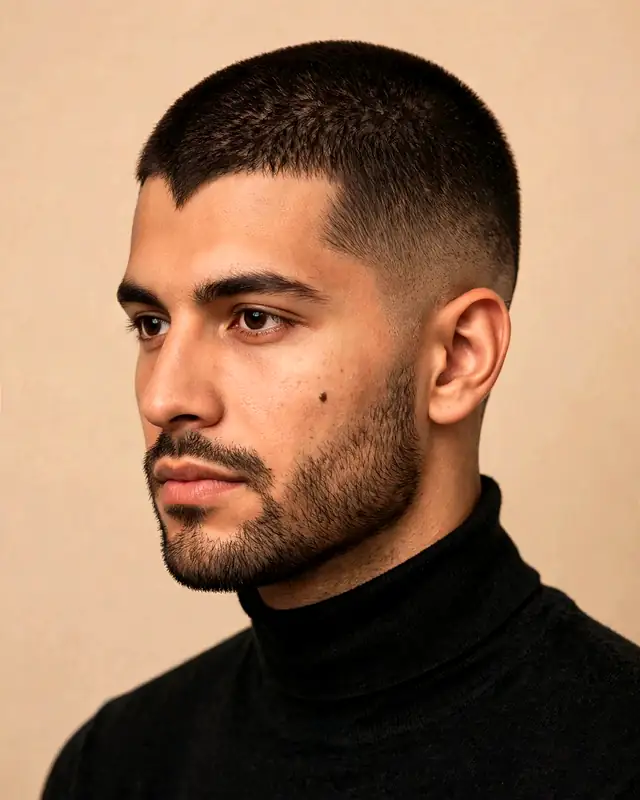
Guard numbers come from the Wahl scale, which most barbers use as the default. A #1 leaves 1/8 inch, a #2 leaves 1/4 inch, a #3 leaves 3/8 inch and a #4 leaves 1/2 inch.
The jump between sizes is bigger than the numbers suggest. A #1 to a #2 doubles the length. A #3 to a #4 adds a third.
That is why the first visit deserves a longer guard than the one you think you want. A barber can always take more off. Putting length back takes weeks.
| Guard | Length | What it looks like |
|---|---|---|
| #1 | 1/8 inch (3 mm) | Close to the scalp, shows every contour |
| #2 | 1/4 inch (6 mm) | Short and sharp, the classic military length |
| #3 | 3/8 inch (10 mm) | Dense and deliberate, the most requested guard |
| #4 | 1/2 inch (13 mm) | Soft texture, the longest true buzz length |
| #5 | 5/8 inch (16 mm) | Borderline crop, needs a little styling |
Two details catch people out. Guard numbers differ by brand. Oster detachable-blade clippers use a different scale, so a #1 on one set of clippers is not the same length as a #1 on another.
And density changes the result. Thick hair holds its shape at a #2, while fine or thinning hair often looks fuller at a #3 or #4, because the extra length adds coverage.
What it looks like from every angle
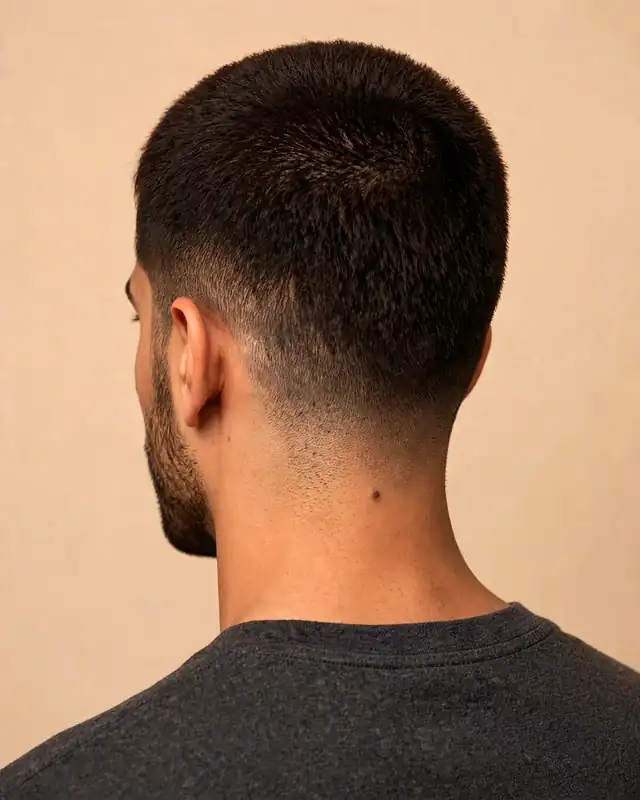
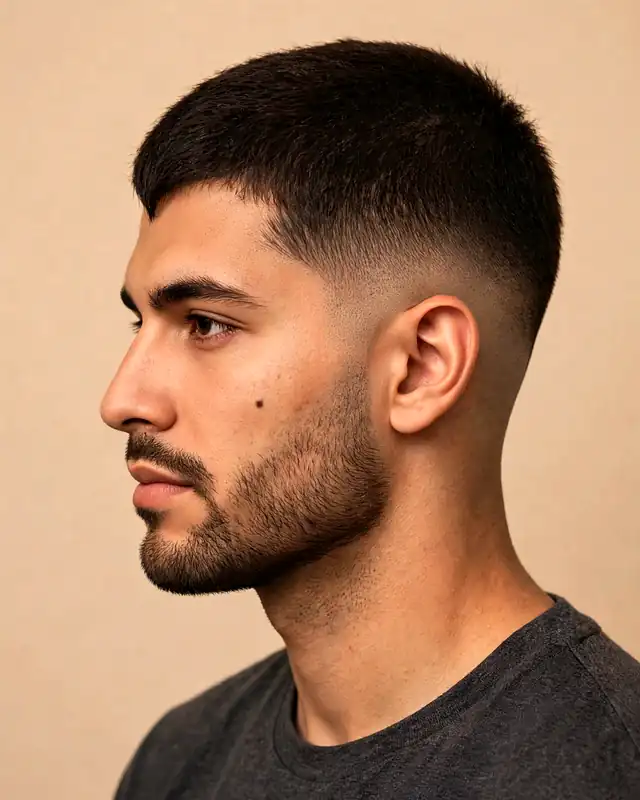
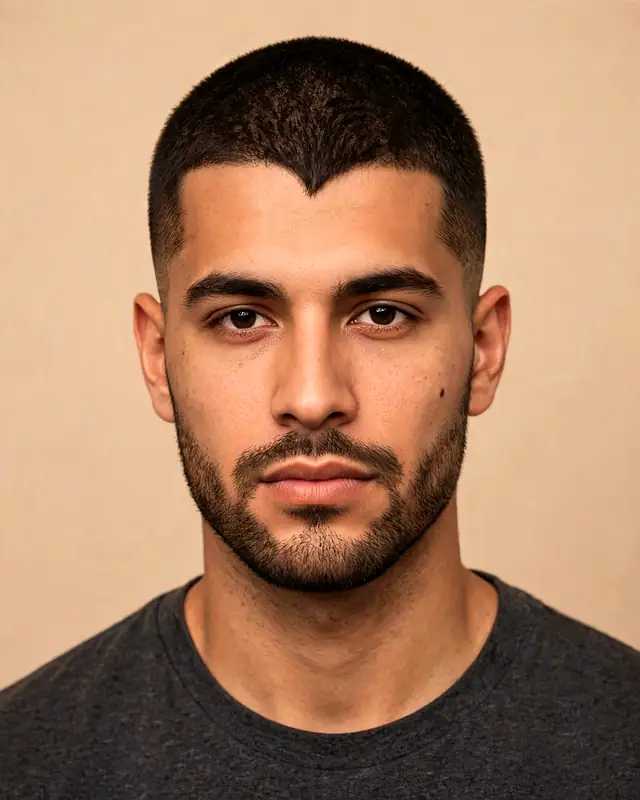
From the front, the cut reads as one short, even length with a clean hairline. From the side, the taper shows as a soft gradient above the ear. From the back, the neckline tapers to a neat finish instead of a hard line.
The front view is where most men judge a low taper fade buzz cut, and it is the least informative angle. A buzzed top and a clean hairline look the same from straight on whether the taper is low, mid or high. The side view tells the real story.
That is where the gradient shows, the soft shift from the top length down to the shortest length just above the ear, and where the sideburn shape sets the frame.
The back view is the one men forget to check. A good low taper finishes the neckline with a smooth blend, no hard line and no sudden step. Ask the barber to hold a mirror up before you leave. The back is the part everyone else sees first when you walk away.
Straight, wavy, curly and coily hair
Hair type changes this cut more than most people expect, and the same guard gives two people different results. Straight hair lies flat and cuts crisp, wavy hair adds volume, and curly hair shrinks, so a #4 on tight curls can settle near a #2.
Straight hair is the easiest case. It lies flat and cuts crisp, so a #2 or #3 gives a sharp result with almost no styling. Wavy hair carries more volume, which means a #2 can look fuller than the same guard on straight hair, and the crown takes a little longer to blend.
Curly hair shrinks. A #4 on tight curls can settle close to a #2 once the curl pulls back, so go a size longer than the length you want to see.
Coily hair needs the taper, not a skin fade. A hard skin line against tight coils looks disconnected, while a taper keeps the transition soft. Clipper over comb gives the barber more control on curls and coils than a guard alone.
Which face shapes it suits
The low taper is forgiving, but top length still deserves a small adjustment per face shape. Round faces gain from a longer top for height, square faces pair well with a line-up, and oblong faces should keep the top short.
Round faces gain the most from a longer top. A #4 adds height on top, which stretches the face visually and balances the width. Square faces pair well with a line-up, since the crisp edge echoes the jawline instead of fighting it. Oval faces have the easiest time, since the proportions already balance, so any guard from #2 to #4 works.
Diamond faces suit a #3 or #4 with a little texture, which softens the cheekbones. Heart faces suit a textured crop, which fills the forehead without adding width at the jaw. Oblong faces should keep the top short, a #2 or #3, so the cut does not add height where the face is already long.
Face shape is a guide, not a rule. Head shape and hairline matter just as much, and a barber who sees your head from every angle will spot what a chart cannot.
Line-ups and shape-ups: getting the edges right
A line-up sharpens the front hairline into a crisp border, while a shape-up tidies the whole outline. On a low taper the edges matter more than people expect, because the fade is subtle and a crisp edge gives the cut its finished look.
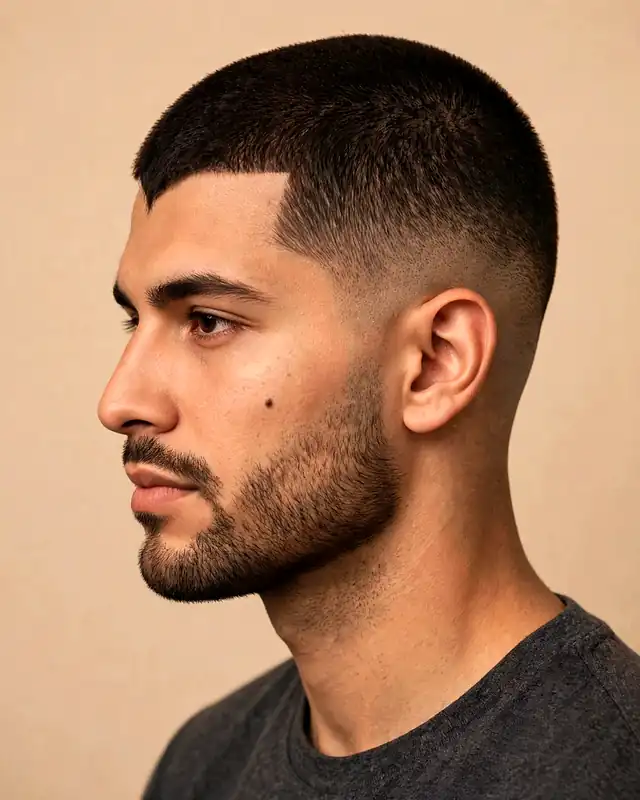
A line-up uses a razor or a trimmer to draw a crisp border along the front hairline. A shape-up tidies the whole outline in one pass. The front hairline gets the same treatment as the sides and the neck, and the sideburns get squared off too. On a low taper the edges carry more weight than they do on a high fade, because the blend is subtle and the outline is what makes the cut look finished.
The trade-off is upkeep. A razor line softens in about a week to ten days, and repeated razoring can push the edge back over months, so men who cut every week sometimes ask for a softer shadow edge instead. If your skin bumps after a razor, say so before the barber starts. A trimmer edge is kinder and still looks clean.
Buzz cut with a beard: connecting the taper
A beard-connected version blends the low taper straight into a faded beard line along the jaw. Hair and beard read as one look. The sideburns are the join, and a clean blend there matters more than the beard length itself.
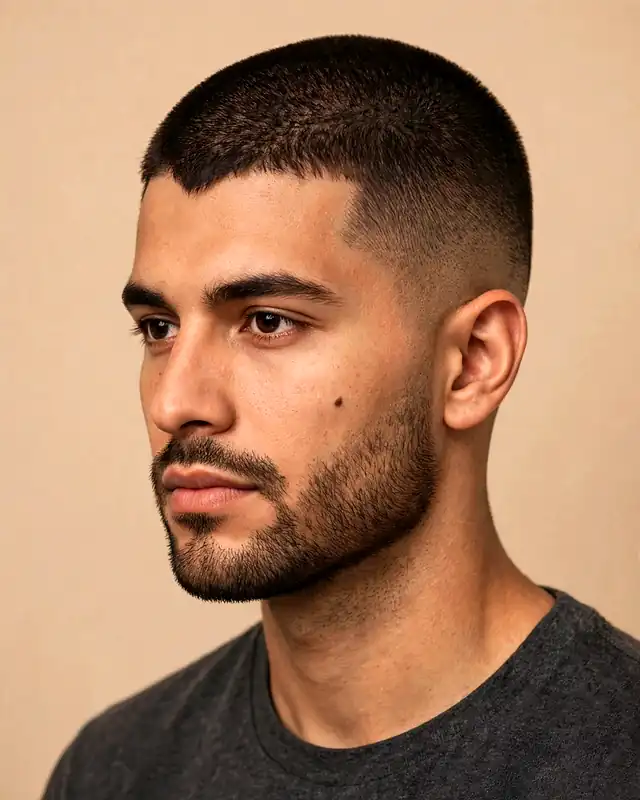
The blend runs from the taper down through the sideburns and into the beard along the jaw, so the hair and the beard read as one shape instead of two separate cuts. The sideburns are the join, and a clean fade there matters more than the beard length itself. A short beard with a clean blend looks sharper than a long beard with a hard step at the sideburn.
Ask the barber to fade the beard line, not just the hair. The beard needs the same two to three week rhythm as the cut, or the blend grows out and the join shows. A little beard oil on the sideburns keeps the transition soft between visits.
What to tell your barber
Give your barber three things: the guard number on top, where the taper starts, and the finish at the bottom. A full ask: a #3 on top, low taper starting just above the ear, not taken to skin, with a soft line-up.
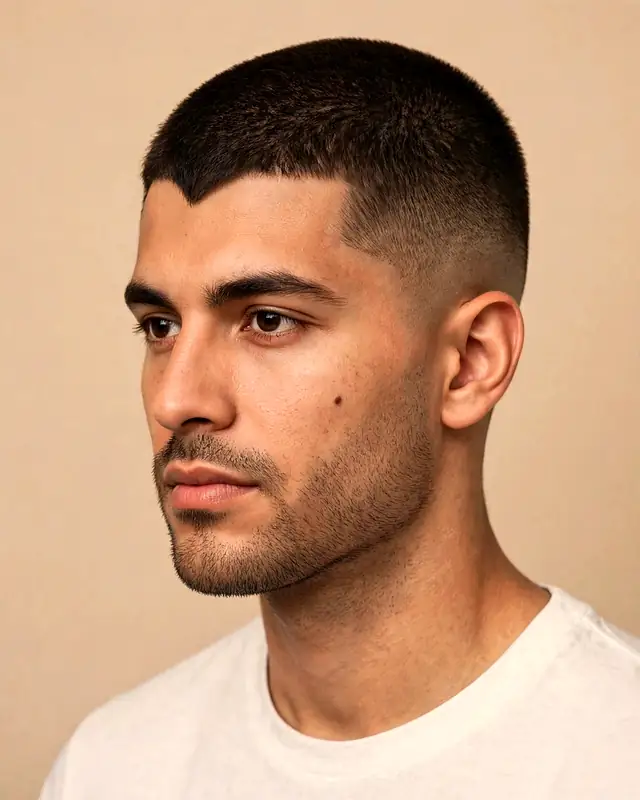
Barbers hear the word low and picture their own training’s version of it, which is why words alone sometimes miss. Pair the ask with a photo of the cut you want, then add the three details.
Guard number. Placement. Finish.
Mention razor-bump history before the barber picks up a razor, and say whether you want a line-up or a soft edge. Before you leave, check the cut in a hand mirror and in window light. The mirror shows the back and the crown. Window light shows the blend without the shop’s overhead glare.
If the taper sits higher than you asked, say so in the chair. A barber can soften a high taper on the spot. Fixing it at home takes weeks.
How to maintain it between visits
A low taper fade buzz cut needs a touch-up every two to three weeks to keep the blend sharp. Past that, the fade grows into one length and loses its shape. Buzz the top yourself between visits, but leave the taper blend to a barber.
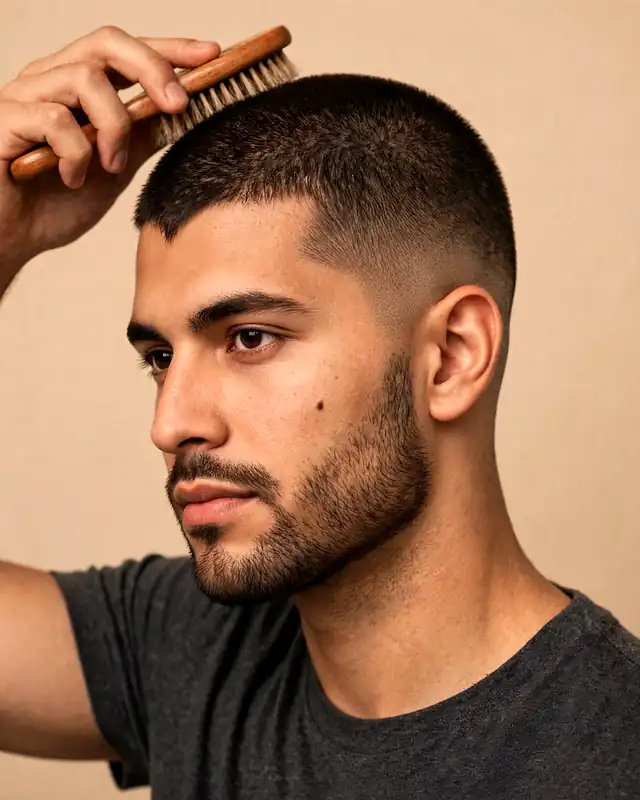
The two to three week rhythm keeps the blend sharp and the neckline clean. A skin finish or a sharp line-up shortens that window to about a week, since regrowth shows fast on bare skin and a crisp edge.
Between visits, the top is easy to touch up at home. Use the same guard each time. Work on hair that is clean and dry, and go against the grain for an even result. A handheld mirror helps you check the back and the crown.
Leave the taper blend to a barber. A slip near the ear shows far more than an uneven top, and a blend is hard to fix once it is cut too high. Scalp care matters more with short hair. Wash it, use a light moisturizer and put sunscreen on exposed scalp in summer, since a buzzed top leaves the scalp open to sunburn.
Who should skip it
The cut suits most men, but skip it if you want to hide an uneven scalp, deep scars or bumps, because short hair shows every contour. It also frustrates men who want length to style, since the top has no parting and no styling range.
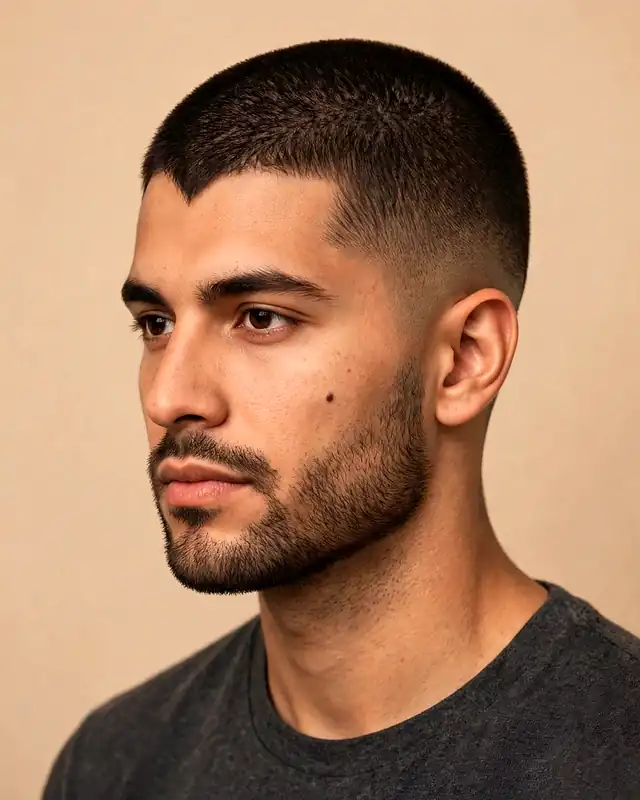
Short hair shows the scalp. A very uneven scalp, deep scars or prominent bumps all become visible at a #2 or #3, and a skin fade shows them more than a taper does. Men with patchy thinning should think twice too. A taper is more forgiving than a skin fade here, since it keeps length over the thin spots, but very patchy hair can still look uneven at short lengths.
The other skip is lifestyle. Men who enjoy styling their hair will find little to work with on a #2 or #3 top, and men who dislike regular barber visits will find the two to three week rhythm a chore. If either of those sounds like you, a longer cut with a low taper gives the same clean sides with more to style on top.
How much it costs and how often to go back
A low taper fade buzz cut runs $30 to $55 at most US barbershops, and $60 to $90 in downtown shops in bigger cities. Plan a visit every two to three weeks, or weekly if you keep a line-up or a skin finish sharp.
The range is wide because the cut is not the same job everywhere. A basic buzz with a low taper at a neighborhood shop sits at the low end. A downtown shop with a line-up, a beard fade and a hot towel finish sits at the high end.
Frequency matters more than price for the total cost. A classic low taper needs a visit every two to three weeks, which works out to about two visits a month. A skin finish or a sharp line-up needs a weekly visit to stay crisp, which doubles the spend. A home clipper set can cut the top between visits and stretch the gap by a week or so, but the taper blend still needs a barber.
Frequently asked questions
The questions below cover the points men ask about most, from touch-up timing to office rules. Each answer is short. The full detail sits in the sections above, so use these answers as a quick check before you book your visit.
How often does it need a touch-up?
Every two to three weeks keeps the blend sharp and the neckline clean. Past three weeks the fade grows into a uniform length and the cut loses its shape, so the visit is about the taper, not the top, which grows out far more forgivingly.
A skin finish or a sharp line-up shortens that window to about a week.
Can I get it with curly or coily hair?
Yes, and it often looks better than a skin fade on curly textures, because the taper keeps length that hides shrinkage and avoids a hard line against the curl pattern. Ask for a guard one size longer than the length you want to see.
Clipper over comb gives the barber more control on tight curls than a guard alone.
Is it OK for an office job?
It is one of the most workplace-friendly fades you can get. The blend stays low, the contrast stays soft, and the cut reads as clean rather than trend-led, which is why it passes in offices where a high skin fade would draw comment.
If your office is strict, skip the line-up and the skin finish.
What guard should I ask for on top?
A #3 is the most common starting point, dense enough to look deliberate and short enough to need no styling. Thinner hair often looks fuller at a #4, while thick hair holds its shape well at a #2 on top.
When in doubt, start longer. A barber can always take more off.
Can I maintain it myself at home?
The top is easy to touch up with clippers between visits, using the same guard each time on clean, dry hair. The taper blend on the sides is the hard part, and a slip near the ear shows far more than an uneven top.
A handheld mirror helps you check the back and the crown.
What is the difference between a low taper and a skin fade?
A low taper keeps a small amount of length at its shortest point, usually a #1 guard, while a skin fade is cut all the way to bare skin. The taper grows out more forgivingly, while the skin fade shows regrowth within a week.
Say the finish out loud when you book, since the word taper alone does not settle it.
Bottom Line
A low taper fade buzz cut works because it solves one specific problem: looking deliberately groomed without daily upkeep. Pick the guard for your density, name the taper placement and finish in plain words, and keep a two to three week rhythm.
Walk into your next appointment with three details ready: the guard number, where the taper starts, and whether it goes to skin. That is the whole ask, and it is enough.